'In this way I shall preserve many things that would otherwise be lost in oblivion. I shall find daily employment for myself, which will save me from indolence and help to keep off the spleen, and I shall lay up a store of entertainment for my after life.'

For James Boswell posts please follow the labels on the right.

This blog mainly contains reviews from the Edinburgh Festivals from 2008 to 2010 which I wrote for the Edinburgh Festivals Magazine. These reviews cover everything from comedy to contemporary dance; children's theatre to Handel.


Showing posts with label Thomas Carlyle. Show all posts

Sunday, 13 November 2011

John Martin Apocalypse Review


On a rock, whose haughty brow
Frowns o'er old Conway's foaming flood 
Robed in the sable garb of woe
With haggard eyes the Poet stood;
(Loose his beard, and hoary hair
Stream'd, like a meteor, to the troubled air)
And with a Master's hand, and Prophet's fire
Struck the deep sorrows of his lyre.

The Bard ~
Thomas Gray
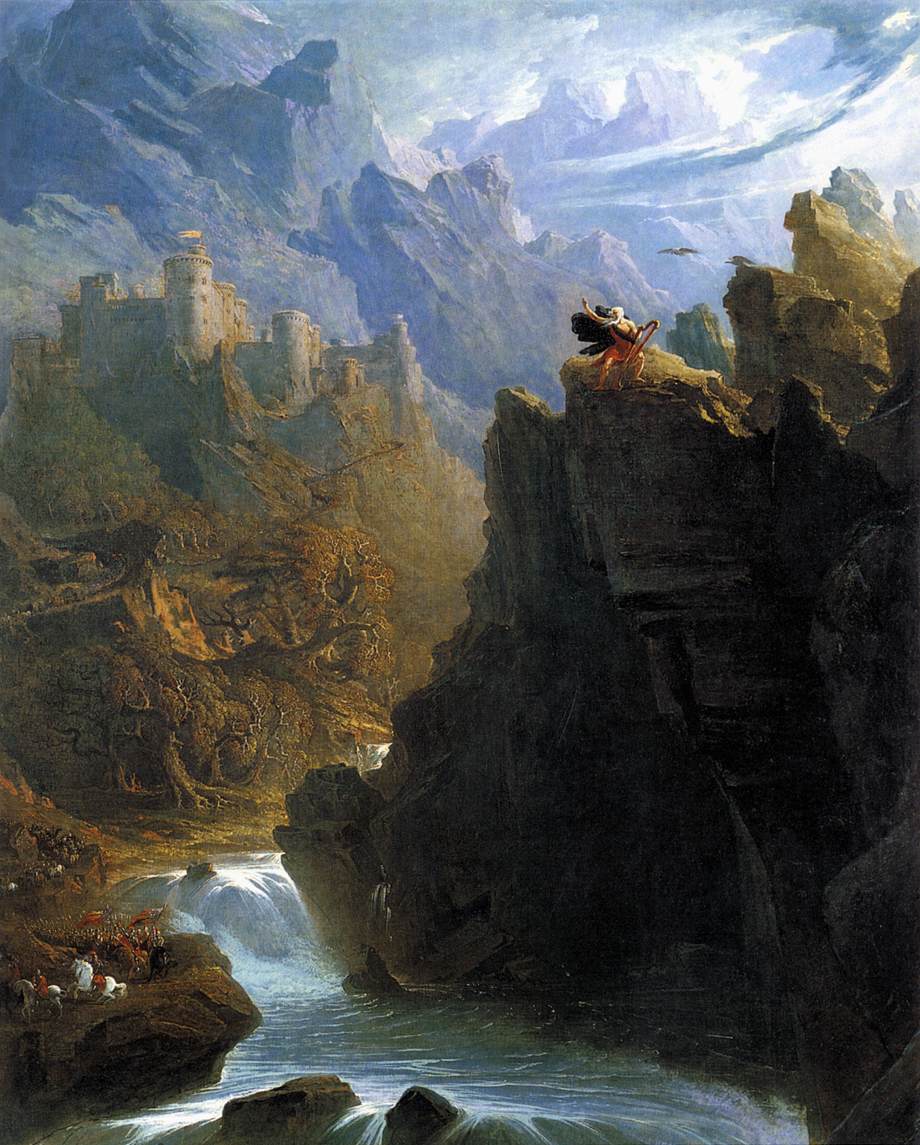


As with the other great event of 1789, there are many overlapping possibilities and routes for interpretation with the figure of John Martin. With him, a horizon of potential explanations opens before us – from Madness to Mammon. The opening image of the Tate Britain's exhibition is Martin's 'The Bard' and it can provide us with several possibilities for understanding his oeuvre. 

The Bard is an arresting and stunning display of man and nature; an image brought about in a cultural milieu of Scott and Wordsworth. The Bard’s mad gesture blends with the jutting landscape; the English army’s progress is defined by the river it trundles past.

Despite the drama of the scene, there is a clear link between Martin's early works and eighteenth-century painters such as Claude. Here – as with 'Pan and Syrinx' – Martin follows the French example, drawing on lush greens and soft blues to provide a pleasant and harmonious landscape for classical games to be played out on. This was familiar and inoffensive. Yet there is a visually striking difference between pieces like this and his other work. Martin’s 1812 piece ‘Sadak in Search of the Waters of Oblivion’ displays a pulsating and despairing scene of a landscape consuming and ruining the individual. The themes, however, collapse into one: Martin is saying that there is essentially man and nature; and despite your modern factories, steam engines and mills, this remains the case. Touching on the sublime is intimately connected with this duality. 


In another sense the Bard represents a deeper idea. The old prophet – the last crumbling bastion of an antediluvian way of thinking – madly attempting to stem the current of an England representing order and progress at the expense of older values. In vain does he challenge the monotonous and inevitable advance of the English army. 

With images like Belshazzar's Feast (1820) Martin takes this critique of the material a step further, thundering a message of Old Testament retribution to a rapt audience. And what better way to remind the masses of His wrath than the vision of hell and the apocalypse? Martin’s apocalyptic scenes of crumbling towers, cities engulfed by torrents of fire and frenzied armies baying wildly into decadent cities became hugely popular for many.

In this sense, Martin is doing more than merely painting images on canvas; he is not simply presenting intellectual ideas or narratives. The overly refined messages, references and puns that defined much of eighteenth-century art in England was already giving way to a love of more emotion and feeling. Martin, like the later Turner, is speaking to the viewers souls; searing lasting impressions. We do not, despite the explanations provided by the Tate, need to delve too deeply to see the messages behind visual testaments like 'The Fall of Babylon'. 

Indeed the exhibition represents a broader sense of spiritual unease felt in Britain after the Napoleonic Wars. It is in this sense that reviews – such as that of Jonathan Jones in the Guardian – pathetically miss the point with Martin. Nineteenth-century Britain after the fall of Napoleon was neither spiritually nor materially stable. It's a sense of unease that for many heralded the black satanic smoke of mechanised Britain blotting out any idea of religion or community; stability succumbing to Peterloo Massacres and negligent Laissez-Faire giving way to Revolutions. 

That revolutionary apocalypse did not engulf Britain says more for the ability of an establishment to listen, adapt and integrate ideas – such as those of Martin or Carlyle – than it does for any inherent British stability post-1815. While Martin's painting lack subtlety and delicacy, they had a profound impact. Attacking the overly complex paintings, the wildly animated figures and pyrotechnic madness of Martin as crass, negates the strong practical reasoning behind them. The Bard then, who is on the cusp of a dramatic leap into the thundering current, does not simply represent the failure to cling to ancient ideas in the face of progress or a glorious romantic outburst culminating in self-immolation. Instead it represents the practical success artists like Martin had in appealing beyond the material and to the very souls of the huddled masses of the nineteenth-century, untouched or unaware of ideas of progress, economics and democracy.

Sunday, 6 November 2011

Melancholia


Like a juror about to pass judgement on a famous celebrity, it seems impossible for a discussion of Melancholia not to drag into their analysis pre-existing prejudices. In this case, the director, Lars von Trier. This is a shame as we are often in danger of getting into such an excited frenzy over the controversial artist that we overlook the work he has produced.

Von Trier! Von Trier! Who is this Von Trier? I would argue that it does not matter. Artists, however self obsessed, are very rarely – Beethoven like – putting themselves fully and consciously at the centre of their works. In truth, most are simply vocal or visual symptoms of a wider zeitgeist; unwittingly amplifying the white noise around them. Others simply present a part of themselves – often in graphic detail – for us all to wince at, never knowing – or daring – to fully immerse themselves in their project.

Occasionally, as I believe with Melancholia, the artist reaches a half-way house – not quite immersing, they nevertheless produce a whole-work of art; a work wrought from a mind aware and suddenly conscious of the spirit of the age it inhabits.

So what then does Melancholia say of the spirit of the age now? The film is not, despite superficial observations, an idyllic one. There is wealth and comfort, but underlying spiritual unease. Throughout, the film is beautiful but it is an uneasy, often unbearable beauty that pervades; the sight of a naked Justine lying by the river side and bathed in cool blue moonlight seems to consume the showy superficiality of the wedding dress, cake and flowers. The consuming beauty is stark and ravishing. It is threatening to onlookers; stunning in its delivery. It is not an easy beauty.

It’s from scenes like this – which reference Ophelia – that our gleefully hacks have jumped on the theme of Germanic culture. The clues are everywhere. The Kandinsky’s are unceremoniously dumped in this film, replaced by Brueghel the Elder and Millias. The strains of Wagner’s prelude to Tristan and Isolde reoccur throughout, and the striking Dunst is seen riding horses through misty pine forests. 

Yet this is simplistic at best, and fails to look beneath the sparkling surface of the Germanic aesthetic. What lurks beneath? Misty pine trees, sparkling blue eyes and castles on remote outcrops: we know what the Germanic ideal looks like, but what does it mean?

As with the ‘Northern’ Renaissance and the later outpouring of Teutonic creativity in the late-eighteenth and early-nineteenth century, Von Trier is reacting against an overly scientific, organised and analytical view of reality which pervades modern culture. The film is an intellectual invasion of a slumbering paradigm of progress, science and reason. Here, perhaps, is the significance of the film.

The key here is not the more obvious Wagner, but Dürer’s woodcut Melancholia. Like the film, Dürer shows a distraught and depressed figure, surrounded by the clutter of science and progress. The apparent triumph of progress and reason is no triumph at all. In the distance hangs a hazy hopeful semi-reality of horizon merging with sea and beyond that a bright light in the sky. As with the film, the bean counting, scientific instruments and refrain of ‘trusting the scientists’ counts for nought here. The world is a creation of the self; external reasoning and logic have little influence on it. It attacks the view – espoused by eighteenth-century French philosophers – that ‘a work of politics, of morality, of criticism, perhaps even of literature, will be fine, all things considered, if made by the hands of a geometer.’  
It’s this obsession with mathematical models, numbering and categorising that the film stands against. The sort of philosophy that, for Isaiah Berlin, ‘operates on lines which are conditioned by the idea that there are certain axiomatic truths, adamantine, unbreakable, from which it is possible by severe logic to deduce certain absolutely infallible conclusion; that it is possible to attain to this kind of absolute wisdom by a special method which he recommends; that there is such a thing as absolute knowledge to be obtained in the world....’ 


What Dürer recognised, as with Wagner, Goethe and later Carlyle in Britain, is the fundamental failure of progress and mechanistic thought to address the problem of the spiritual vacuum they create. Where to turn to for inspiration or wonder? For Carlyle, who reacted strongly against the emotional desert progress had created, the consequences were clear to see and in need of remedy:


We Boasted ourselves a Rational University; in the highest degree hostile to Mysticism; thus was the young vacant mind furnished with much talk about Progress of the Species, Dark Ages, Prejudice, and the like; so that all were quickly enough blown out into a state of windy argumentativeness; whereby the better sort had soon to end in sick, impotent Scepticism; the worser sort explode in finished Self-conceit, and to all spiritual intents become dead. But this too is portion of mankind's lot. If our era is the Era of Unbelief, why murmur under it; is there not a better coming, nay come? As in long-drawn systole and long-drawn diastole, must the period of Faith alternate with the period of Denial; must the vernal growth, the summer luxuriance of all Opinions, Spiritual Representations and Creations, be followed by, and again follow, the autumnal decay, the winter dissolution.


Friday, 21 January 2011

Please refrain from analysing in the Cathedral

I recently visited St Paul's and attended the Epiphany Procession. The Cathedral is generally regarded as one of the high points of European Baroque. Yet unlike many buildings of its scale, there is no grand approach; it emerges all at once out of a cluster of tightly packed city houses. Despite its mighty and looming exterior, the inner architectural harmony of the Cathedral serves to relax the pilgrim. The design, by Wren, was heavily influenced by the light forms of continental architecture; at the time the dome was considered slightly too Papish.


What, for me, was initially an excursion for an enquiring mind, turned into something more spiritual. I am not, mind, in any way religious. Yet the music and architecture piety can produce do serve to lighten the soul and give a feeling of renewal and calm. I could, of course, try to analyse these thoughts and probably come to some sort of pseudo-scientific conclusion: harmonious music and space; the effects of singing; the general mood of the congregation. Yet this would be to sully the sense that 'church' made me feel better. 


St Paul's Cathedral by Cannaletto painted in 1754.
Indeed, after far to much learning about eighteenth-century philosophy, I am increasingly seeing the merits in reacting against analysis, numbers and pure reason. Our society is surely reaching a saturation point, culturally and spiritually, with its obsession with figures, graphs and numerical proof. There are scientific formulas for Happiness, Weight Loss and a Good Christmas; Powerpoint presentations, plans and diagrams on 'How to be Good' or 'How to feel Better'. We have somehow managed to pinpoint the Worst Day of the year. Advertising companies use statistics to convince us that our eyelashes can have '4 times more Impact'.


Obviously these should not all taken with the same seriousness as, say, the mathematics behind a medical vaccine. But what about political numbers used to prove an argument? What about the omnipotent question of the Budget Deficit? The danger is that analysis goes beyond being a mere prop for decision making, and becomes in itself the irrefutable answer to a problem. Understandable then, was the reaction of Thomas Carlyle to many of the high ideals of analysis and reason in the eighteenth century. One of the greatest intellectual feats of the century, Adam Smith's Wealth of Nations, was for Carlyle the beginning of 'the dismal science' of economics. 


Yet the view of the time of Boswell as one of 'Reason' is slightly misguided, and has, like 'Enlightenment', been applied after the fact. It might as well, as many historians have pointed out, been called an age of 'Passion'. Certainly in Boswell we find an impassioned lover, moody writer and angry young man. He is prone to fluctuating emotions, and his 'whims' stand in marked contrast with a rigorous accounting process for his expenditure. 'The pleasure of gratifying a whim is very great. It is known only by those who are whimsical.' Indeed, in an interesting city with no immediate regulated pattern of work, the point is well made; going 'walk about' in London (without a map or direction) is always an interesting experience. 


Furthermore, Boswell's love for women and socialising is the stuff of legend. Even at church, 'In the midst of divine service I was laying plans for having women...I have a warm heart and a vivacious fancy. I am therefore given to love, and also to piety and gratitude to God, and to the most brilliant and showy method of public worship.' On another occasion, his piety is clouded out: ‘I was on honour much disposed to be a Christian. Yet I was rather cold in my devotion. The Duchess of Grafton attracted my eyes rather too much.’ 


Alas, no such talent at this week's service.